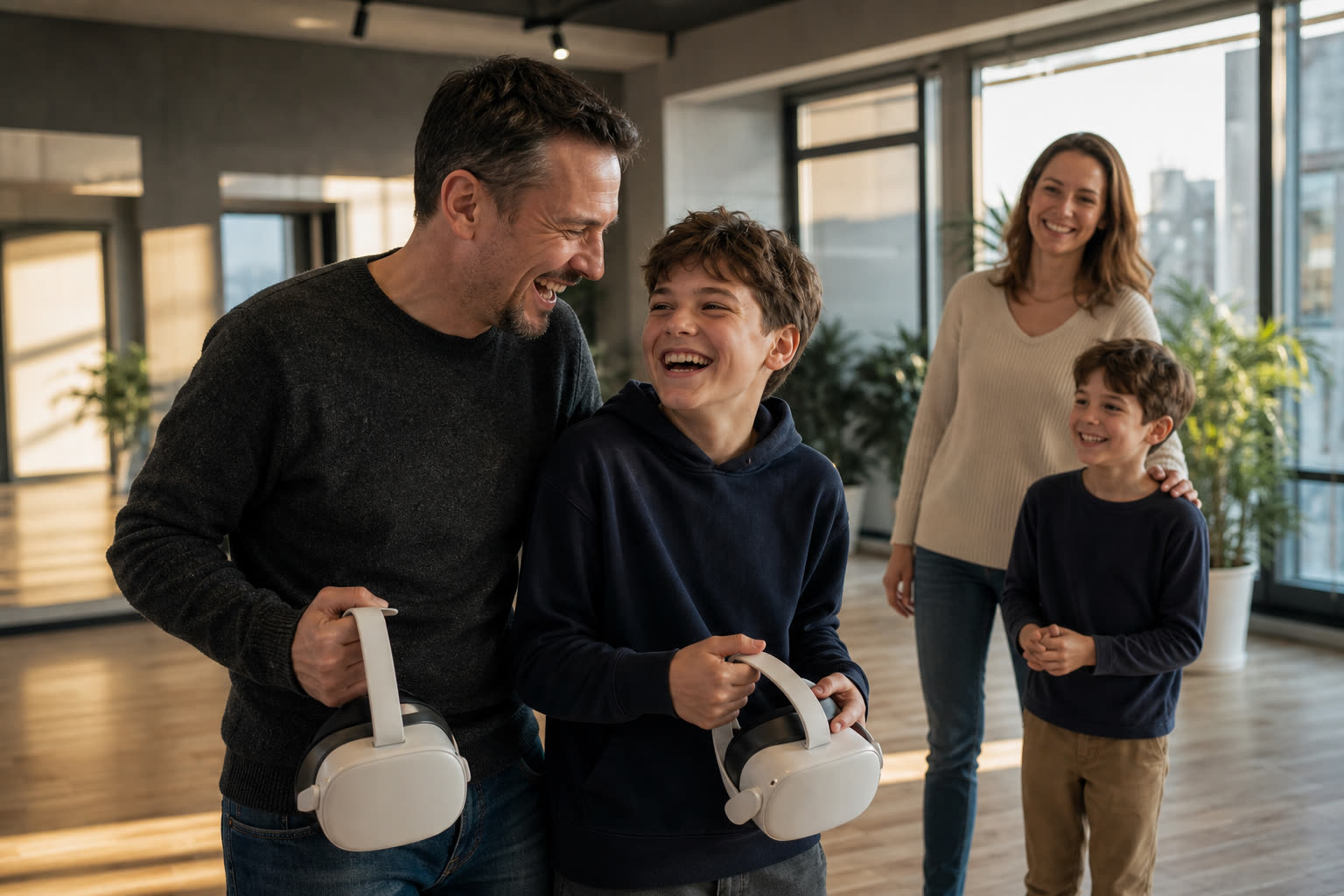
A shared family programme: when dad or mum actually plays with the child
You do not need a whole weekend. One shared round between a parent and a child — or the whole family — leaves trust that is still there on the way home.
For most of the week a parent and a child move on two separate tracks. School, work, phone, the evening “how was your day?” — and both feel the conversation is short. Not because there is no love. Because there are few situations where you do the same thing, in the same rhythm, and neither of you stands above the other. A shared programme — dad with his son, mum with her daughter, or the whole family — creates exactly that. And the effect does not end when you take your shoes off.
The lasting part: trust in the parents grows
A child trusts a parent more when they see them not only stating rules, but taking a risk, making a mistake, laughing at their own miss. In a shared game that is unavoidable. Dad misses the ball. Mum does not get the rule immediately. The child wins — and the parent does not explain why it did not count. That scene stays. Later, when a hard conversation comes (school, a friend, the phone), the child has a fresh memory: this adult was with me, not above me. Trust is not a one-evening genre. But after a well-chosen shared hour, the door opens more easily for weeks.
- The child takes home that the parent can lose — and that makes the adult safer.
- The parent takes home that their child is more competent than everyday arguments suggest.
- The rest of the family (who did not even play) get this tone at dinner: less tension, more shared jokes.
Dad with the child, mum with the child — two people is enough
It does not always have to be a full family day. In fact: an hour one-to-one is often stronger. Dad and the ten-year-old, mum and the teen, grandparent and grandchild — one adult who does not look at their phone for 90 minutes. A child rarely gets that undivided. And it is a relief for the other parent: you do not have to “organise a programme for the whole house”, one of you taking them is enough. Trust grows because someone was specifically there with you — not because of how many people stood around you.
When the whole family comes
If everyone is there after all, the gain is different: the children see the parents playing with each other too. Not only “mum is taking us”, but mum and dad laughing in the same round. That is good for the marriage, and for the child — because the family looks like a team, not logistics. The younger sibling who is only watching still takes the memory: we were together, and nobody was bored on the bench.
What kind of programme actually does this?
Not every “family programme” works this way. Cinema: you sit next to each other, but you do not play. Restaurant: the child asks for the phone, the adult asks for the bill. Trust grows when there is a stake, there is laughter, and the parent is not the organiser but a teammate.
- A game where the parent is not a pro either — otherwise they become the teacher again.
- A length that fits an afternoon: 1.5–2 hours, not an all-day hike.
- Indoors, if it is an autumn Sunday and you do not want the weather to decide.
- A place where the child can win too. If the adult always takes it, hierarchy stays instead of trust.
VR for a family: the same map, the same laughter
At PartyVR this setup is exactly what works. Meta Quest 3, 8 headsets, Újbuda, next to Allee. Dad or mum puts on the same headset as the child — and in 10 minutes both are clumsy, then both are good. The child sees the parent lose. The parent sees the child teach. That rarely happens in the kitchen.
- Walkabout Mini Golf – a calm shared round, an easy on-ramp if someone is wary of VR.
- Beat Saber – rhythm, arms, laughter. The teen is often better. That is the point.
- Gorilla Tag – tag, movement, nobody stays on the bench.
- The others see it on the projector — the younger sibling or the other parent is not “waiting”, they are cheering.
Age: we welcome ages 8+, with supervision for 8–13. Younger than that needs a parent present and a prior chat — under 10, no. If the child is still small for the headset, they can come and watch with the other parent, or you can wait a year. You do not have to force it for trust.
A weekend shared round does not fix everything at home. But it gives a memory you can still point to later: “remember when dad also fell over on the golf course?” That sentence softens the next argument too. That is why it is worth booking — not for the game, but for what stays after.
Ready to go?
Book a VR slot online in District XI — takes minutes, or browse by occasion.
More articles
 Beat Saber: Become a Rhythm Game Master at PartyVR Budapest StudioGet ready for the most popular rhythm game in virtual reality! Our detailed guide shows you how to master light sabers using PartyVR Budapest's Quest 3 headsets.
 Superhero Birthday in the Heart of Budapest: How to Turn Your Kid's Party into an Unforgettable Quest 3 VR AdventureDiscover how your child can become a real-life superhero for a day with cutting-edge Quest 3 VR technology. A family atmosphere, exciting games, and unforgettable memories await you.
 How Does Quest 3's Latest Technology Blur Reality with Gaming?Discover how Meta Quest 3 transforms your living room into a battlefield or a magic kingdom using mixed reality, while keeping the outside world in sight.